Pages

Monday, July 15, 2013

New FAA Rule Will Hurt Small City Air Service - >> The Cranky Flier

New FAA Rule Will Hurt Small City Air Service - >> The Cranky Flier:

Express Pilots


'via Blog this'

Re-Blogging this from "The Cranky Flier."  I blogged about these new requirements and the impending pilot shortage last year (The Upcoming Pilot Shortage...... Made Worse by the Federal Government, July 25. 2012).  In my humble opinion, it is not just the "small city air service," which will suffer, but everyone.  We (taxpayers) already spend billions subsidizing "small city air service."  Hey, if you live in or near a city or town that cannot sustain a profitable air carrier service, and you really need it, then perhaps its time you thought about moving or seeking another form of transportation.
In any case, what the author of this says is correct.  No one is going to pay over 100K to learn how to fly AND then build up 1500 hours just to make 22K per year.  Government is always about the good intentions, but never considers the unintended consequences or the actual outcome of their legislation.  As long as everyone "feels good," and that they are least "doing something," then the outcome doesn't matter.
Just sayin.....

Sunday, May 5, 2013

Boston, Reverence and Revelry (Revere too)


I was actually scheduled for this layover long before the bombings occurred.  Now I was to arrive nine days after the vicious terror bombings of APR 15th.  It was a beautiful Spring day and though still chilly, a great day for a walk.  Our hotel was one block from the site of the second bomb.  I took a circuitous route, walking towards Copley Square and avoiding Boylston Street as I would walk back that way.  The city was alive with blossoms of spring and lots of tourists.  There was a reverence in the air and by the time I got to Copley Square, the mood quickly changed as I neared the makeshift memorial created there by the people.  Everywhere were "Boston Strong" signs and the somberness of those walking among the memorabilia was so reminiscent of NYC after 9-11 near the site of the twin towers.  The street had just been opened the day before and the sites were no longer cordoned off.  
Site of first bombing near the finish line.


Second Bombing site
I continued my walk and was able to see the second site.  I kept walking on Boylston street with Fenway Park as my destination.  I had been there once, many years ago to see a game.  I actually lived outside of Boston after graduating from college.  Boston is a great town and on prior layovers, I was able to see Old Ironsides and the commons, as well as eat at a terrific oyster bar.  The Summer Shack is across from our hotel and I can highly recommend it for oysters.  As I got to Fenway, there were preparations underway for that evenings game.  I relaxed and decided to get a "Tasty Burger," enjoying it at a table outside.  My stroll back was easy as I took in the sunshine, the sights and noted some places to try for future visits to Bean Town, a great place to go, especially in the Spring and Summer months.                                            

Copley Square & Memorial in the background
Fenway


Statue of Paul Revere

Tasty Burger & Fenway Park In the Background

Under the "Green Monster" on Lansdown St.


Memorial memorabilia

NYC and Eataly


On approach to LGA
OK, What can you write about NYC that hasn't already been written?  We are put up in a downtown Manhattan hotel, near West 35th street.  It is easy walking distance to everything, really.  It was a beautiful Spring day, temps around upper 60's.  My goal was to put a couple of "checks in the block" so to speak and to do some things that I had not done on prior visits to New York City.  Going to the top of the Empire State and checking out Times Square at night were two of those things, but my priority was, of course, food. That is how I found myself walking to Eataly, ( http://www.eataly.com ) the pantheon of Italian foods this side of the Atlantic.  It was founded by Oscar Farinette, Joe Bastianich, Lidia  Bastianich, Mario Batalli, and Adam and Alex Saper.  For me, my real discovery of Italian food was when I was stationed in Naples, during one of my Navy assignments.  I was the Officer in Charge of a Helicopter detachment that provided support services to the Mediterranean Sixth Fleet.  We were housed in a tourist/camping complex that also had one of the most popular restaurants in the area.  It is here where I had my first taste of Mozarella di Bufala.  I was hooked.  Naples (not New York as some like to say) is where pizza was born.  Combine the chewy, blistered dough with a perfect Marinara sauce and real buffalo mozzarella and you have pizza perfection.  That is what I had here at Eataly.  That and the delight of simply "touring" the place and seeing all that it has to offer in Italian gastronomic delights.  Having "checked that off and spending over an hour here, I then set off to continue my exploration.   I decided to wait in the lines for the Empire State tour.  They were long, but I could see that they could have been longer.  It took a lot of patience from me to stick it out, since my views of the city as I fly into LGA are pretty fantastic (and free), but this was one of the "checks in the block" that I was determined to get.  If you can tolerate the crowds (and NYC is all about crowds), then it is still worth doing.  From there I walked to Times Square, checked that off and then dragged my self back to the hotel, where I poured myself into bed, exhausted and fulfilled.   
Eataly, in the Flatiron district
The Flatiron Building

Empire State Building

View from the top

Times Square 

Thursday, April 11, 2013

The hacker who claims he can crash your plane......and other Science Fiction


The hacker who claims he can crash your plane

"You can use this system to modify approximately everything related to the navigation of the plane... that includes a lot of nasty things"
Hugo Teso, a security researcher from German consultancy agency N.Runs, claims he can hijack an airplane's navigation systems using a smartphone app, radio transmitter, and flight software he purchased off eBay.
Speaking at this week's Hack in the Box conference in Amsterdam, Tesso "employed a Samsung Galaxy smartphone to demonstrate how he could adjust the heading, altitude, and speed of a virtual airplane by sending it false navigation data,"reports InformationWeek.
"You can use this system to modify approximately everything related to the navigation of the plane," Teso tells Forbes. "That includes a lot of nasty things."
The smartphone app he developed, nicknamed PlaneSploit, takes advantage of a plane's Aircraft Communications Addressing and Report System (ACARS), which uses short transmissions to beam data between aircraft and satellites. The problem, says Teso, is that "ACARS has no security at all." Anyone can transmit fake data to alter an aircraft's trajectory.
The airplane has no means to know if the messages it receives are valid or not. So they accept them and you can use them to upload data to the airplane that triggers these vulnerabilities. And then it's game over.   What kind of damage are we talking about, exactly? Here's Computerworld with the rundown:
Once he was into the airplane's computer, he was able to manipulate the steering of a Boeing jet while the aircraft was in "autopilot" mode. The only countermeasure available to pilots, if they even realized they were being hacked, would be to turn off autopilot. Yet many planes no longer have old analog instruments for manual flying. Teso said he could take control of most all airplane systems; he could even cause the plane to crash by setting it on a collision course with another plane. He could also give the passengers a serious adrenaline rush by making the oxygen masks drop down.[Computerworld]
Honeywell, one of the aerospace companies behind the ACARS system, says that it is taking the alleged exploit very seriously, and confirmed that it's been in talks with N.Runs to review Teso's research. However, a Honeywell spokesperson says Teso's ability to commandeer an aircraft remotely may be overblown.
The software is "normally available as an online pilot training aid," a Honeywell rep tellsInformationWeek. "In other words, what Teso did was hack a PC-based training version of [the flight management system] that's used to simulate the flight environment, not the actual certified flight software installed on an aircraft." 
Teso says his firm has alerted the Federal Aviation Administration (FAA) and the European Aviation Safety Administration (EASA), and is working with them to fix the vulnerabilities.

Monday, March 25, 2013

Closed Control Towers and Airport Operations (The Sequestration Scare)

View the full size photo! Control Tower LIBD Airport Bari - Palese (Karol Wojtyla) - LIBD     With all the news reports of airport control towers closing and the implied looming disaster that would occur because of that, I felt obliged to comment on this.  For those of you who are pilots, I am certain that you have received similar questions.  A friend of mine asked me the other night if I had landed at an airports with closed towers recently.  He asked this in a way that implied that this was going to be something new and dangerous to my profession as an airline pilot.
     He was quite surprised when I told him that, yes, I have in fact landed at airports with closed control towers.  I have landed at airports that had no control towers.  Airports operating without a control tower is not unusual.  As long as aviation has existed, pilots have been landing without speaking to or needing a controller in a tower.  Obviously, extremely busy airports that have very vibrant and important control towers (ATL, ORD, LAX, etc) are not the ones that are being closed to save money. In fact, all of the airports that are closing are not even operated by FAA personnel.  They are so-called "contract" towers.
They are towers that are manned and operated by employees of companies that have been contracted by the FAA to operate the towers at a significant cost savings to the FAA, which means you and me, the taxpayer.   
     There are many reasons for this.  Most of, if not all of the 149 airports that will have their towers closed were airports that had previously operated without towers.  In order to "increase the margin of safety," a tower and controllers were added under the "contract" program because it simply was not cost effective to put a full time FAA government employee there.  All of these contract tower airports that will be closed have fewer than 150 thousand flight operations per year.  That is among ALL of them.  That averages out to about 83 operations per month.  The most dangerous things these contract operators do is battle boredom.
Are these places now more dangerous to fly into? No. Does having a tower operator improve safety? Sure, if that person is alert (remember the controller who fell asleep at Washington National?) and if the flight operations occur during the operating times of the tower.  If a pilot is landing at the airport after the tower operating hours, then he is landing at an "uncontrolled airport."  Which is something that even commercial airline pilots do frequently.  Sometimes, on very early morning departures, we have to take off before the tower is opened.  We get our flight "release" from air traffic control center and self announce on a Common Traffic Advisory Frequency (CTAF) to communicate with any other aircraft that may be on or around the airport.  We coordinate among ourselves as to who is where and who will go first and from what runway, then we take off making an announcement on the same frequency before we switch to the "center" frequency.  
     The same is true if we arrive at an airport after the tower has closed.  We coordinate with the "center" and self announce on CTAF to sequence ourselves in if there is other traffic arriving or departing.  This is how most non commercial airports operate.  At all of these "sequester" airports, fewer than 10 thousand commercial passenger flight operations occur each year.  

In fact, at Pocatella, Idaho, (PIH), one of the 149 slated to have their control tower closed, this is the announcement on the airport website:

“The FAA announced today that the Air Traffic Control Tower at Pocatello Regional Airport will be closed sometime after April 7, 2013.  The airport itself will remain open and continue to operate normally.  The tower closure does not impair or jeopardize the safety and security of regular air service and passengers will not detect any change.  Most other general aviation traffic will also be unaffected. 
 A well-tested protocol for operating at an uncontrolled airport is already in place at Pocatello because the tower closes each evening. 
The other towers to be closed in Idaho are located in Hailey, Idaho Falls, and Lewiston.  Twin Falls’ tower will remain open for now because it has federal employees that provide a special service for Burley airport.
Again, Pocatello Regional Airport will remain open and safety and security are not compromised. 

     All of this statement is true.  They are alluding to the CTAF procedures I just mentioned.  THAT is the well-tested protocol already in place.  As they mention, the tower closes each evening.  Planes still come and go.  Lighting for the runways and taxiways is controlled by the pilot using the CTAF radio frequency via a series of clicks on the microphone.   They have three daily scheduled commercial flights that will continue to operate.
     As a pilot, so much responsibility is placed on us anyway.  The Lexington, KY (LEX) crash in August of 2006 occurred at an airport with an operating control tower (that was open) and had the controller been paying attention, he could have prevented that crash by informing the crew that they were lined up on the incorrect runway.  This was noted in the accident report, but ultimately the cause was "pilot error."  They also noted the configuration of the airport, which, at the time, made it easy for this mistake to occur if you were not paying attention (the airport has since been redesigned).
     So without getting into the politics of all of this, (and trust me, there are politics involved) you can relax amid the noise and confusion and "the sky is falling!" (a little pun there) rhetoric you are hearing.  Every Control Tower where it is vital to have controllers will remain open.  All of these are operated by FAA personnel.  The real casualty is the job of the contract controller who, more than likely, was a retired FAA controller anyway receiving a government pension (though I am speculating about that).   

Thursday, March 21, 2013

"Flight".....The movie and Reality


OK, I give.  After numerous questions about this movie, I finally was able to watch it after downloading it to my DVR.  I watched about half of it before turning it off and going to bed.  I am very sensitive when it comes to alcohol and drug abuse in our industry.  I and 99.9% of every airline pilot are professionals and very strict rule followers when it comes to procedures, checklists and safety.  It is ingrained into our DNA the moment we start flight training.  For those of us who have prior military experience, even more so.  Certainly, there have been those who have been caught and when it happens, they get a lot of publicity since airline crew are so highly scrutinized.  Occasionally, you will learn about other transportation professionals who were caught drinking or abusing drugs (train, bus, ship drivers for example).  Addiction is a non discriminatory disease and education, training and environmental development makes no difference.    BUT..........remember folks, this is Hollywood, NOT reality.  Several points:

1.   We, like many professions are subject to random drug and alcohol tests.  Just last week, between flights, I was subjected to a breathalyzer and urinalysis.  Whip Whitaker would never have gotten to become a senior captain at an airline, because at some point in time, he would have been caught.  Could he have escaped through sheer luck and been able to avoid any screening?  It is possible, but not likely.  Peers would have brought his behavior up to a chief pilot, who would have addressed the issue right away.   Drug and alcohol abuse by a crew member is taken VERY seriously and addressed immediately.  If caught, they are fired.  If they self report, they are given treatment.

2.  Jokes about the pilot drinking as you board or after you are on board ARE NOT FUNNY.  You might as well be joking about a bomb being on board.  I was once standing in the cockpit door greeting passengers drinking a soft drink in a cup with ice when a boarding passenger said, "I hope that's just a coke."  I looked at him with a very serious look and told him, "Sir, we don't even joke about that."  He was taken aback and a bit upset, but frankly I didn't care.  What if the passenger behind him had overheard that remark and didn't realize that he was making a joke?  Suddenly one passenger has a "suspicion or a doubt."  If that issue is raised and rumors begin or it is mentioned to a fight attendant, I am walking off the plane and going straight to the testing facility.  The flight is delayed while another pilot is found and my reputation, my profession, my livelihood is intact.  Joking about the pilots drinking when you are on the airplane is not funny nor wise.  Needless to say, I don't even drink water in view of passengers anymore.  In fact, on the few occasions when I make my PA to passengers standing in the aisle, (which I do when there is an unusual delay and I want to be sure that the passengers understand what is going on) now I make sure that my hands are visible to the passengers so they don't think I am pulling a "Whip Whitaker," and pouring myself a cocktail while I talk to them...sheeesh!  

3.  Can an airliner really fly "upside down?"   Of course.  While not a fighter jet or an aerobatic airplane, airliners ARE airplanes and can fly inverted.  We practice getting out of this condition (known as an unusual attitude) in our annual simulator sessions.  When Boeing introduced the 707 and was demonstrating its capabilities to potential buyers at the International Air Transport Association (IATA) gathering in Seattle, when it was a prototype and before it became the backbone of most airlines, the test pilot Tex Johnson actually "rolled" it.  I have a link to the video below.  The boss of Boeing was not pleased, but they certainly sold a lot of 707's. 
http://www.youtube.com/watch?v=Ra_khhzuFlE   Now, the odds of this actually happening on an airliner are extremely remote.  There was an accident off the coast of California where a jack screw failed on an Alaska Airlines flight.  That fatal crash spurred significant changes in the maintenance of elevator jack screws.

4.  Taking off with a line of thunderstorms in front of you is stupid.  I don't care how well you can read a radar, you don't fly through a thunderstorm and try to "find a clear area," behind it.  That is a recipe for disaster.  Often times, radar will mask a tornado, hail or more severe weather in area that appears clear. If we see an area of storms, we avoid them.  Staying on the ground until it passes is the most prudent thing to do and is what we all do since most storms move very quickly.  Will there be some turbulence as we bypass a storm?  Possibly, but it won't be severe like it would be inside of an area of thunderstorms.

5.  Most portrayals of airline pilots in the movies are incorrect (except that we are all handsome) ;-).  Much of the dialogue on the radios they show are not realistic and we don't sit there constantly staring out the front gripping the yoke (flight control).  We also don't fall asleep and turn over all responsibilities to the other pilot.  We do drink coffee to stay alert, and get up to stretch.  Staying alert, sharp and maintaining situational awareness while we are flying is paramount and that is why there are two of us and we will never be replaced by a computer.

So, as you watch these movies, be entertained and know that much of what you see is fictional and unrealistic as it has to be, otherwise you would be bored.  Flying is hours of boredom punctuated by rare moments of excitement.  As my Navy CO used to say, "Boring is good." 


Thursday, March 14, 2013

How to make your flight less miserable | Compass - Yahoo! Travel

How to make your flight less miserable | Compass - Yahoo! Travel:

An article in Yahoo, by Drew Limsky.  My comments and responses are in BOLD


How to make your flight less miserable


By  | Compass – Tue, Mar 12, 2013 2:34 PM EDT
(Photo: Digital Vision / Thinkstock)
Air travel has become so uncomfortable that preserving your sanity means perfecting your flying ritual. Be prepared and methodical, and once you deplane you’ll barely remember the trip even happened.
Quick change
Refrain from being one of those annoying people at the check-in counter having some protracted negotiation with the agent, or one of those couples or families who expect five passengers to change their seats to accommodate you. If you’re traveling with a group, or think that your itinerary or seating might be the least bit complex, handle it over the phone before you ever get to the terminal. Once at the airport, use the check-in kiosks (sometimes they even work). Frequent fliers know to approach the counter only to ask for something specific and quickly achieved, like a seat in an empty row, a seat in the emergency row, or to check on upgrade status.  There are now so many options, including websites and mobile apps that you can use to change your seat and check in.  Use a phone call as a last resort, especially if there are irregular operations going on due to weather disruptions.  You don't even need paper anymore to board.  Airlines don't even require you to register to be a frequent flier to use the website.  Just use the "record locator number" to find your booking.  It is usually a series of numbers and letters....The Captain
Loyalty matters
Attaining a frequent-flier level in which you’re routinely upgraded is the holy grail of flying. For me, it’s not about the food; it’s only marginally about the free liquor; it’s all about the seat and the sleep. Even paying for a pricier ticket on your preferred airline to maintain your elite status is worth it, because each upgrade to Business is worth several thousand dollars and priceless peace of mind.  Flying in the front is the best.  No doubt about that.  We always take very good care of our frequent fliers.  They deserve it.  Flying is a for-profit business, not a social equality program....C
Carry on my wayward son
(Photo: Creatas / Thinkstock)Nothing signals an inexperienced traveler more than checked baggage. Avoid it at all costs; it’s expensive in both time and money. Observing this rule for a long weekend trip is easy. Paradoxically, using a carry-on for a month-long trip is also a no-brainer, because then I know it’s incumbent on me to find a cheap laundromat or agreeable housekeeper in my final destination. It’s those trips in between those two durations that are a challenge. Still, you should resist the urge to check luggage. Shop around for the biggest bag that will legally fit in the overhead compartment and supplement it with the most expandable shoulder bag that you can find.  Yes, but.....be reasonable and conscientious.  You will have to actually "lift" it to the overhead bin.  So unless you lift weights regularly, keep it light.  Moreover, on many regional jets, you will have to gate check your bag (at no cost) and retrieve it on the jet bridge at your destination.......C

Smart security
The key to getting through the security line quickly is to mentally rehearse your ritual beforehand. Be sure that you can easily slide your computer out of your bag, that you can slip out of your shoes in seconds (laces are the enemy), and that your toiletries don’t exceed 3.4 ounces each. (In my experience, most airports have relaxed the toiletries-in-the-clear-bag rule, so I’d risk dispensing with it.) Belts, mobile devices, and other metals go into your bag or coat before you ever get out of the taxi.  Amen to that.  I still see some pretty silly stuff at security.  Fortunately, crew members get head of line privileges and are able to skip it entirely using a pre-screening program at some major airports.  But, don't get me started on the TSA.....C
See no evil
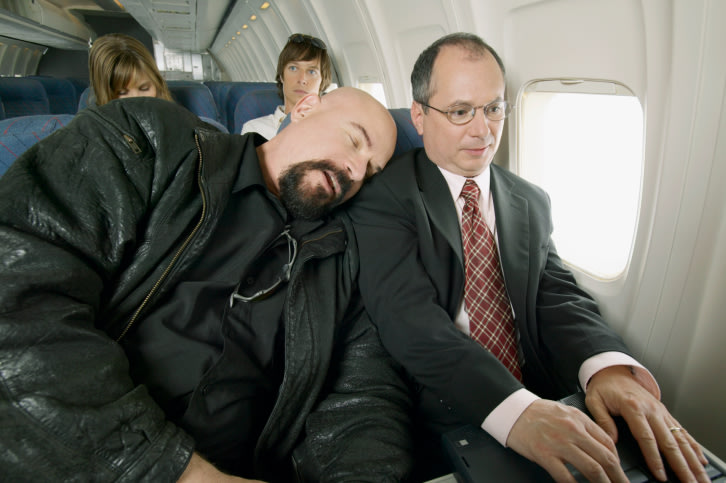
Sensory deprivation, Part 1: unless you have work that absolutely can’t wait or you spy someone on the plane you’d like to get to know, the best way to experience flying is not to. Make over-the-counter sleep aids and/or controlled substances your friends, and use a sleep mask or a baseball cap pulled down low to get to your dark place and alert talkative neighbors and solicitous flight attendants that you’d like some privacy. Your choice of flight plays into this, too: the first flight of the morning, after you've gotten barely three hours of sleep, will almost guarantee coma, and red-eyes are fine opportunities to avoid consciousness.  Nothing says "leave me alone and don't talk to me," like a sleep mask over your eyes and ear buds.  When I "dead head" (fly in the back en-route to an airport where I will eventually work a flight), I want to catch up on my sleep.  I really don't want people asking me (as I sit there in my pilot uniform), if I am a pilot, or "aren't you supposed to be in the front?" and other inane questions....C
(Photo: Digital Vision / Thinkstock)

Hear no evil
Sensory deprivation, Part 2: You should never get on a plane without earplugs. Untested fliers tend to project as if they’re onstage. There are all kinds of things you just don’t want to hear on board, beyond the ubiquitous crying babies: couples arguing, strangers flirting, flight attendants gossiping, and business people relentlessly talking about revenue goals and optimization.  Earplugs, then noise canceling headset when electronic devices are allowed to be turned on. (see my blog on electronic devices) are essential.  I once sat on a plane where a drunk sang (very poorly) the entire Beatles repertoire.....C
Rockin’ and rollin’
A lot of people get nervous during turbulence even if they don’t show it. First off, take the announcements about “chop” with a grain of salt. Often, by the time the pilot or flight attendant finishes describing how bumpy this patch is, the bumpy patch is done. Second, when you feel some bumps, stare at your water bottle in the seatback pocket; notice that the water is barely moving. This reality check will give you some perspective. Another self-soothing strategy: Consider how much bumpier a ride on Metro North or the subway is than the choppy flight you’re on—and remember that those modes of transport don’t even require seat belts. Third, if you feel that your anxiety level will become intolerable, see above note about controlled substances.  See my blog on Turbulence....C
Hydration, hydration, hydration
There are a lot of things you don’t need for the flight, but water is essential. Flying is notoriously dehydrating (bring chapstick). I’ve found very few airports in the world that don’t sell bottles of water beyond the security checkpoint, so buy it even if it’s overpriced (it always will be). Don’t be at the mercy of the flight attendant rolling down the aisle with “free” beverages (something that costs you anxiety is not free). And what if you run out of water just as it gets choppy and you need to swallow a controlled substance, now? Yes, hydrate, hydrate....C
Fliers’ digest
In my opinion, the food is never so good on the plane—even in First Class—that it’s worth missing out on sleep. It’s just plain uncomfortable to have a full belly in a tight seat, and if you’re a nervous flier, that speedy infusion of calories will make your heart race even faster. On the other hand, it’s wise to bring some trail mix or other snacks in case you get into one of those rare time-consuming scenarios—delayed on the tarmac or circling in the air. Either way, choose a seat that’s close (but not too close) to the plane’s restroom. Yes, but don't bring extremely pungent food on board.  Remember, be conscientious, you are traveling in a pressurized tube with lots of other people....C
Temperature control
It doesn’t matter if you’re flying to and from the hottest places on Earth; once you’re at 35,000 feet, it’s cold. So don’t make the common mistake of under-dressing because you’re on vacation. Always layer. Always wear socks. I’ve found a hoodie indispensible for warmth, comfort, and versatility—you can use it as a blanket over your legs. Bringing a blanket for the plane is a waste of space and makes you look like a tool. (A hooded sweatshirt just makes you look like an overage skateboarder, or a Californian, which is better than looking like a tool.) A travel item that has multiple uses is worth its weight in gold; your hoodie does double duty.  I have never understood why folks wear flip flops, tank tops and pajamas.  Your feet will get cold, your body will get cold.  The temperature is never perfect.  Moreover, if in the extremely unlikely scenario of an emergency evacuation, you will most likely be barefoot as you egress. (See my blog on What not to Wear on an Airplane).  Dress as if you were going for a walk outside.....C